

On January 27, 2025, Nvidia — the undisputed king of AI chips — lost $589 billion in market value. In a single day. That's roughly the entire GDP of Sweden, wiped out before lunch.
The trigger? A Chinese startup called DeepSeek released an AI model that allegedly matched America's best — built for a fraction of the cost. Panic hit. Investors ran. The Nasdaq shed a trillion dollars. And millions of everyday people who had poured their savings into "the AI revolution" watched their portfolios bleed red.
Here's the twist: Nvidia's stock recovered within weeks. The people who panic-sold locked in real losses. The people who held — or bought the dip — came out ahead.
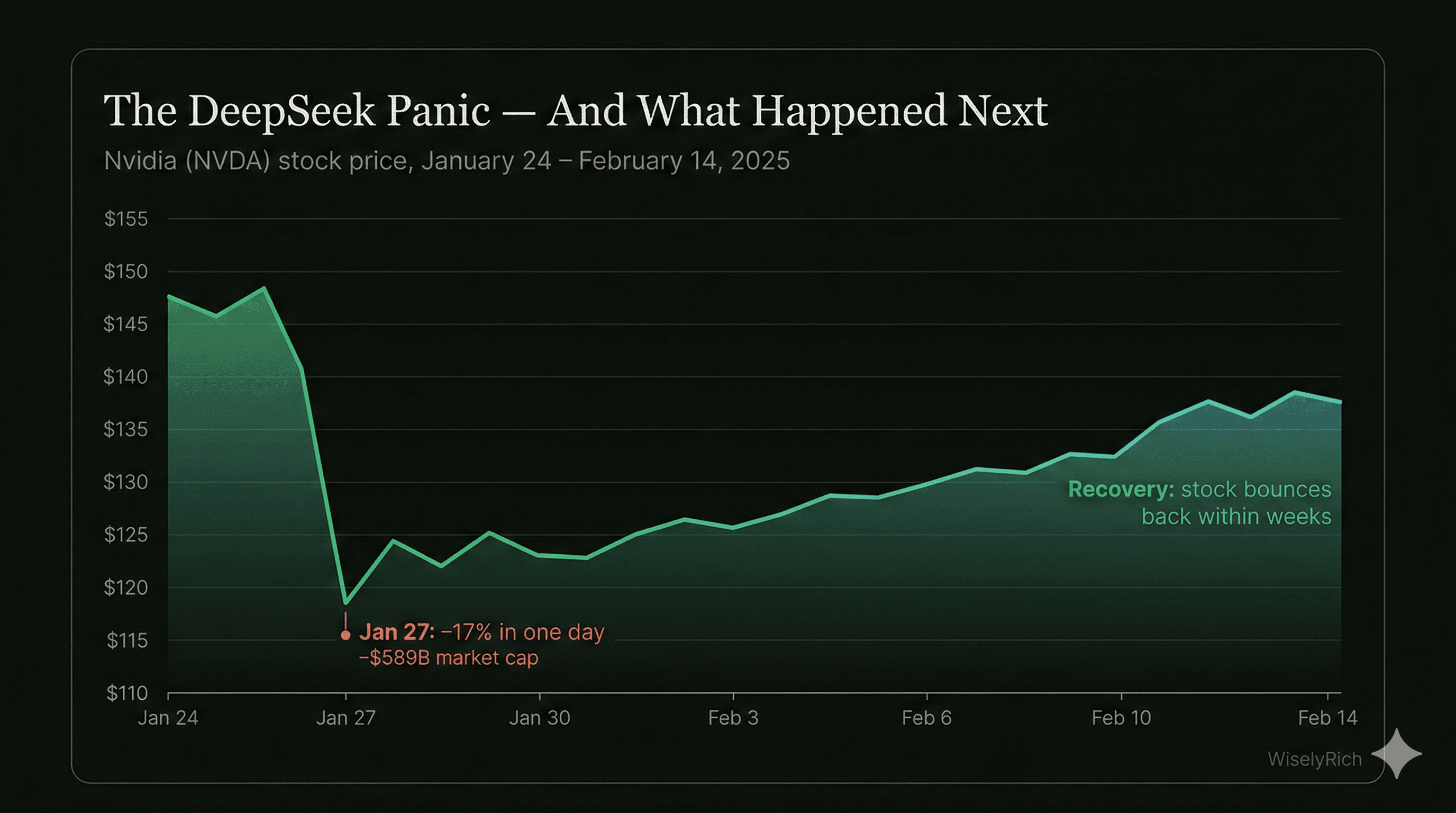
Nvidia lost $589B in a single day — then recovered within weeks. The people who panic-sold missed the bounce.
That single episode tells you everything you need to know about AI investing in 2026. The opportunity is massive. The hype is deafening. And the difference between building wealth and burning cash comes down to strategy, not speculation.
AI spending is projected to hit $2.5 trillion globally this year, according to research firm Gartner. The global AI market could grow from $184 billion in 2024 to over $826 billion by 2030, according to Global X research. This isn't a fad. It's an economic shift as fundamental as the internet itself.
But here's what nobody's saying on the hype-driven YouTube thumbnails: you don't need to pick the next Nvidia to profit from AI. In fact, trying to do exactly that is how most beginners lose money. In this guide, you'll learn five concrete strategies to invest in AI intelligently — strategies that protect your downside while giving you real exposure to the biggest technological shift of our lifetime.
Why the "Just Buy Nvidia" Approach Will Burn You
Let's start with the uncomfortable truth.
If your entire AI investing strategy is buying shares of the hottest company you saw on social media, you're not investing. You're gambling with a narrative.
Nvidia returned over 170% in 2024. Incredible. But that same stock dropped 17% in a single day when DeepSeek spooked the market — the largest single-day market cap loss in U.S. stock market history. Investors who bought at the peak and sold during the panic didn't participate in the recovery. They just ate the loss.
This is what happens when you chase momentum without a plan. Think of it like surfing: riding a wave is thrilling, but if you don't know when to paddle and when to pull back, the ocean doesn't care how excited you were.
The broader lesson? Individual AI stocks are volatile by nature. Leadership rotates fast. Today's dominant player can become tomorrow's cautionary tale. The dot-com era proved this: for every Amazon that survived, there were hundreds of Pets.coms that didn't.
Your job isn't to predict who wins the AI race. Your job is to make sure you profit no matter who crosses the finish line first.
But how do you do that when every headline is screaming about a different stock?
Strategy 1: Use AI ETFs to Spread Your Bets Across the Entire Ecosystem
If picking individual AI stocks is like betting on one horse, buying an AI-focused ETF is like owning a piece of the whole racetrack.
An ETF — exchange-traded fund — bundles dozens, sometimes hundreds, of stocks into a single investment you can buy with one click. You get instant exposure to chipmakers, cloud providers, software companies, and robotics firms all at once. If one company stumbles, the others can carry your returns.
Here are three AI ETFs worth knowing in 2026:
Global X Artificial Intelligence & Technology ETF (AIQ) holds 85 stocks across the AI ecosystem, from Nvidia and Taiwan Semiconductor to Apple and Cisco. It manages over $7.5 billion in assets with an expense ratio of 0.68%. Analysts project over 30% upside potential over the next 12 months.
Roundhill Generative AI & Technology ETF (CHAT) takes a more focused approach with 48 stocks specifically tied to generative AI. It uses a proprietary scoring system that evaluates companies by their actual AI revenue, R&D investment, and profit contribution — not just whether they mention "AI" in earnings calls.
Invesco AI and Next Gen Software ETF (IGPT) leans toward semiconductor designers, AI software developers, and cloud infrastructure providers. It has gained over 22% in the past six months alone, with an expense ratio of 0.56%.
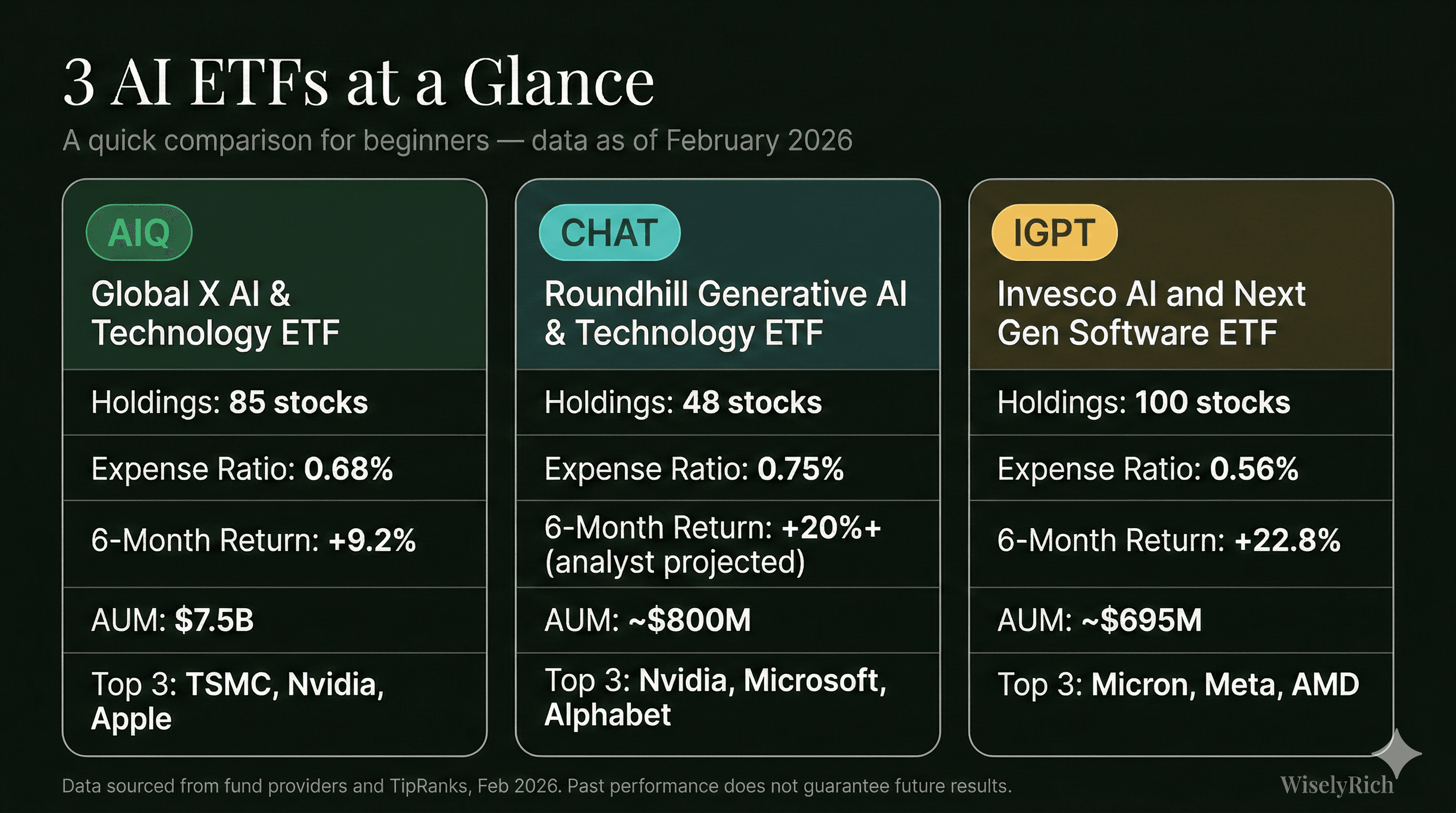
Three AI ETFs compared: holdings, expense ratios, and what each fund focuses on.
The beauty of ETFs? You don't need to be right about which company wins. You just need to be right about the trend — and AI infrastructure spending says the trend is very much alive.
Your action step: Open your brokerage account, search for one of these ETFs, and compare their top holdings, expense ratios, and recent performance. Even $50/month into a diversified AI ETF puts you in the game.
Strategy 2: Don't Sleep on the "Boring" AI Picks — The Picks and Shovels
During the California Gold Rush, most prospectors went broke. You know who got rich? The people selling shovels, tents, and jeans.
The same principle applies to AI. Everyone's obsessing over which chatbot or AI model will "win." Meanwhile, the companies supplying the infrastructure that every AI company needs are printing money regardless of who comes out on top.
Think about it this way:
Taiwan Semiconductor (TSMC) manufactures the chips for Nvidia, AMD, Apple, and Broadcom. It doesn't matter which AI company you're bullish on — there's a strong chance TSMC is making their hardware.
Semiconductor equipment makers like ASML build the machines that print microscopic designs on chips. No ASML machines, no advanced chips. Period.
Cloud infrastructure providers — Amazon Web Services, Microsoft Azure, and Google Cloud — are the landlords of the AI economy. Every AI startup, every enterprise deploying models, every company fine-tuning a large language model is renting compute from these three.
Energy and cooling companies are the emerging dark horse. AI data centers are energy-hungry monsters. Power demand from AI data centers is compounding 22% to 33% annually. Companies providing power solutions, cooling systems, and grid infrastructure are quietly becoming essential AI investments.
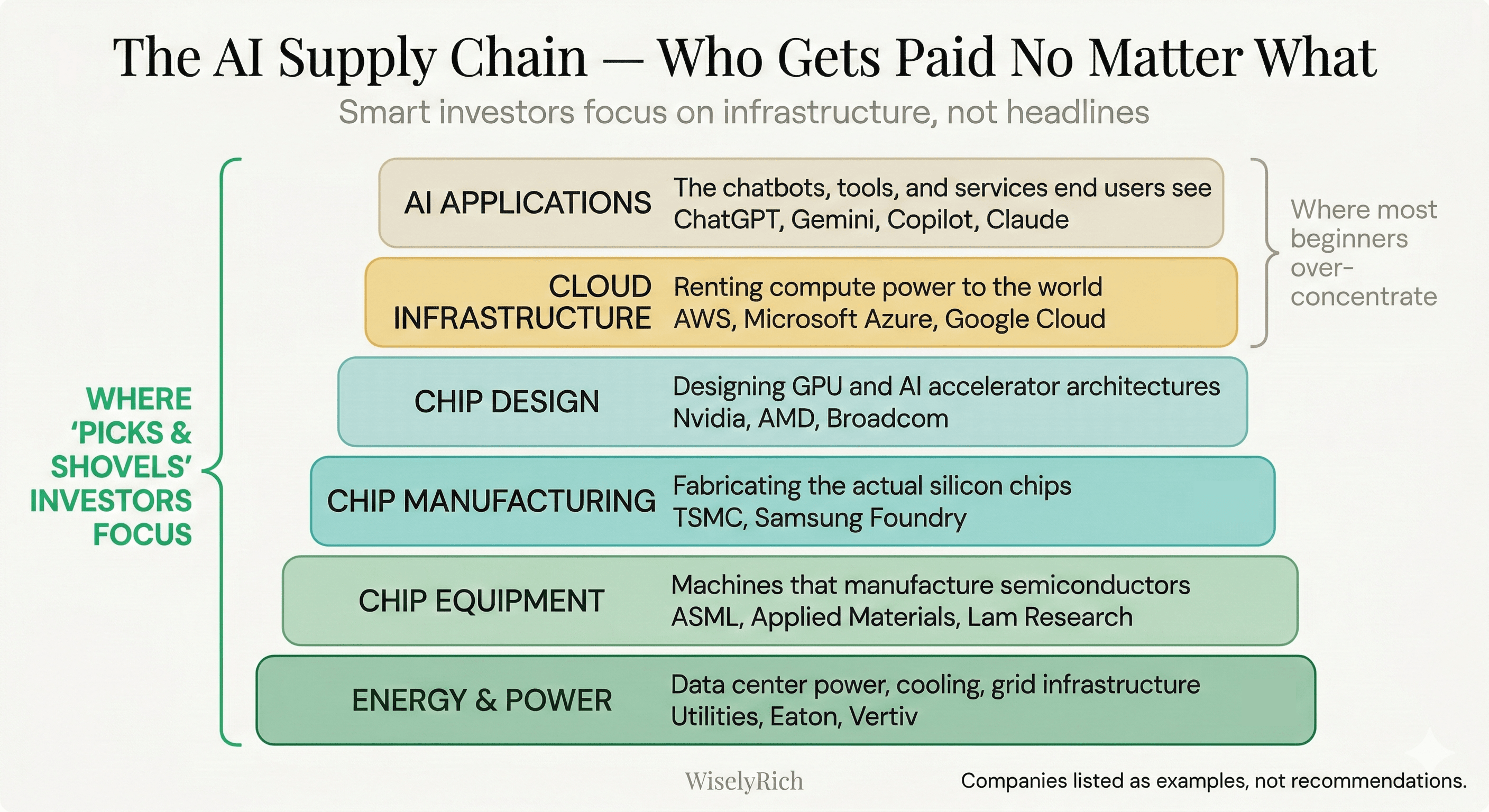
The AI supply chain: smart money targets the bottom four layers — the infrastructure everyone needs.
The "picks and shovels" approach lets you invest in AI's certainty — the infrastructure — instead of AI's uncertainty — which end product wins.
Your action step: Look at the top holdings of any AI ETF. You'll notice they're dominated by infrastructure companies. That's not an accident. Smart money follows the supply chain, not the hype cycle.
Wait — Isn't This Just Another Bubble?
Fair question. You've probably seen the headlines comparing AI to the dot-com crash. One analyst called AI "the biggest and most dangerous bubble the world has ever seen" — 17 times larger than the dot-com bust. OpenAI's CEO Sam Altman himself has acknowledged bubble dynamics. So what's going on?
Here's the honest answer: parts of the AI market probably are overvalued, and parts of it absolutely aren't. The difference comes down to one word — earnings.
During the dot-com era, companies with zero revenue and no path to profitability were valued at billions. Today's AI leaders — Nvidia, Microsoft, Meta, Alphabet — are reporting record profits. Nvidia alone earned $0.89 per share in Q4 2025, beating analyst expectations by nearly 6%. That's real money, not vapor.
But caution is still warranted. A February 2026 study from the National Bureau of Economic Research found that 90% of firms reported no measurable productivity impact from AI — even as executives projected it would boost output. The S&P 500's valuation is at its highest since the dot-com peak. And OpenAI has committed to over $1 trillion in infrastructure spending while still operating at a loss.
The lesson isn't to avoid AI investing. It's to invest in a way that protects you whether the music keeps playing or the dance floor clears. That's what the next three strategies are built to do.
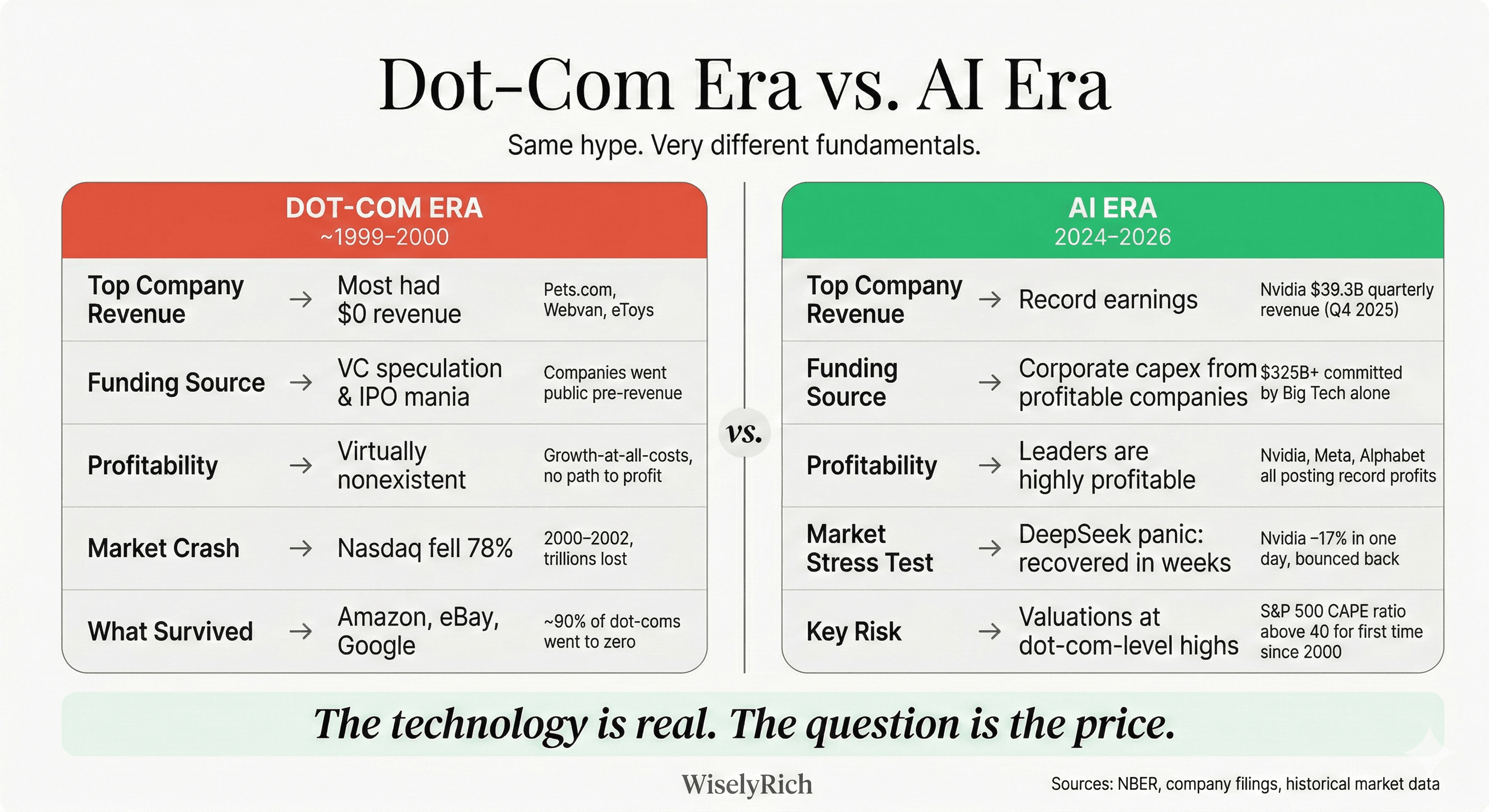
Dot-Com vs. AI — the technology is real this time, but so are the valuations. Caution and strategy beat blind optimism.
Strategy 3: Dollar-Cost Average — Let Time Be Your Bodyguard
If the DeepSeek crash taught us anything, it's this: nobody can time the AI market. Not Wall Street analysts, not hedge fund managers, and certainly not you scrolling Reddit at midnight.
But here's the good news: you don't have to.
Dollar-cost averaging (DCA) means investing a fixed amount at regular intervals — say, $100 every two weeks — regardless of whether the market is up or down. When prices drop, your fixed amount buys more shares. When prices rise, your existing shares are worth more. Over time, this smooths out volatility and removes the emotional rollercoaster from your investing.
Here's a quick example. Imagine you invested $300 into an AI ETF over three months:
- Month 1: Price is $60/share → you buy 5 shares
- Month 2: Price drops to $50/share (DeepSeek-style panic) → you buy 6 shares
- Month 3: Price recovers to $65/share → you buy 4.6 shares
Total: 15.6 shares at an average cost of $57.69 each. If you'd put all $300 in during Month 1, you'd own just 5 shares at $60 each. Same money, fewer shares, higher average cost.
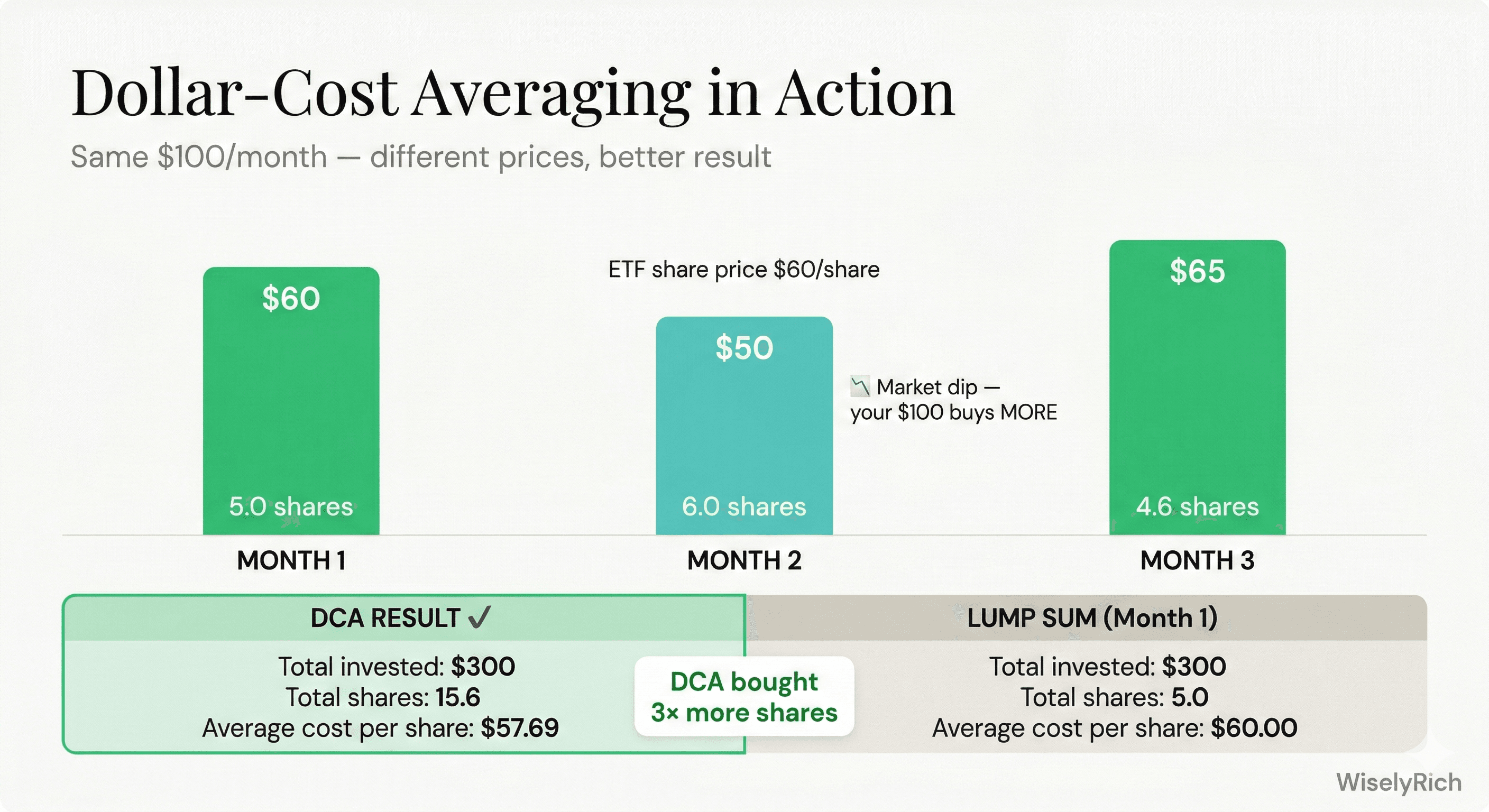
Dollar-cost averaging in action: same $300, more shares, lower average cost.
DCA won't make you rich overnight. But it will keep you from making the classic beginner mistake: buying at the top because of excitement, and selling at the bottom because of fear.
Your action step: Set up an automatic recurring investment through your brokerage. Pick a number you won't miss — even $25/week — and commit to it for at least 12 months. Then stop checking the price daily.
Strategy 4: Anchor Your AI Bets With a Boring, Diversified Core
Here's a mental model that will save you from yourself: think of your portfolio like a pizza.
The base — your crust and cheese — should be broad, diversified index funds. Something like a total U.S. stock market fund or an S&P 500 index fund. This is the foundation. It's not sexy. It won't make dinner party conversation. But it delivers steady, long-term growth that has averaged roughly 10% per year over the past century.
Your toppings? That's where AI-focused investments go. Maybe 10–20% of your total portfolio. Enough to benefit meaningfully if AI delivers on its promise, but not so much that a single bad week wrecks your financial life.
This approach is called core-satellite investing, and it's how many professional portfolio managers structure their holdings. The core gives you stability. The satellites give you upside.
Why does this matter for AI specifically? Because thematic sectors — even legitimately transformative ones — go through brutal drawdowns. Tech stocks lost over 75% of their value between 2000 and 2002. They eventually came roaring back. But the people who had 100% of their money in tech couldn't afford to wait.
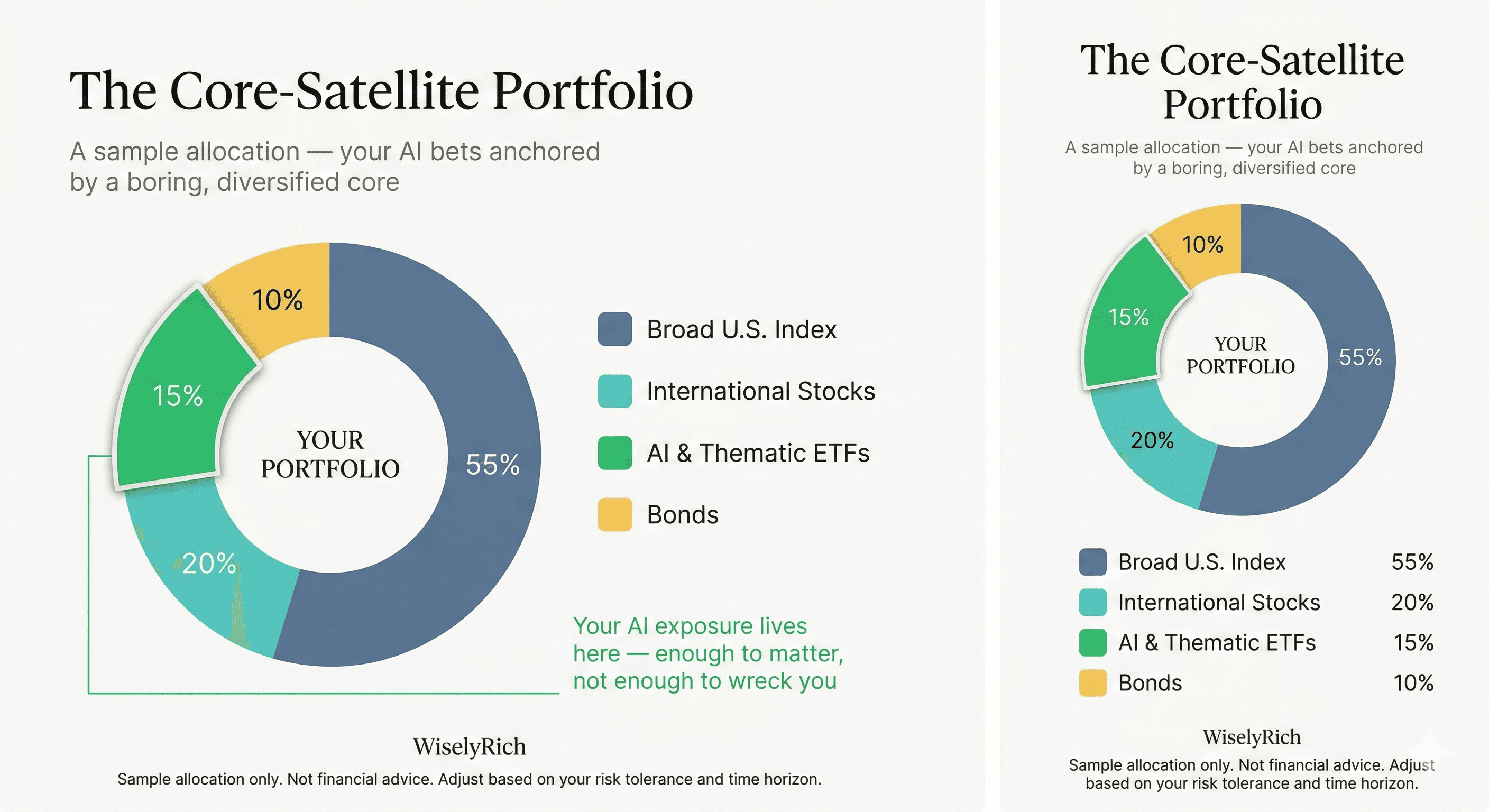
A sample core-satellite split: 85% stable core, 15% AI exposure. Enough upside without betting the farm.
Your action step: Before you invest another dollar in AI, check your overall portfolio balance. If more than 20% is in any single sector, you're concentrated, not diversified. Rebalance first. Then add your AI exposure as a satellite.
Strategy 5: Think in Decades, Not Headlines
The biggest risk in AI investing isn't a crash. It's quitting too early.
Gartner projects AI spending at $2.5 trillion in 2026. Morgan Stanley estimates global data center spending between 2025 and 2028 will hit $3 trillion. These aren't speculative guesses — they're institutional projections backed by committed capital from the world's most profitable companies.
Amazon has earmarked roughly $100 billion in capital expenditures, heavily weighted toward AI and cloud. Microsoft: $80 billion. Alphabet: $85 billion. Meta: up to $72 billion. These companies aren't spending this kind of money on a whim. They're building the infrastructure for the next decade of computing.
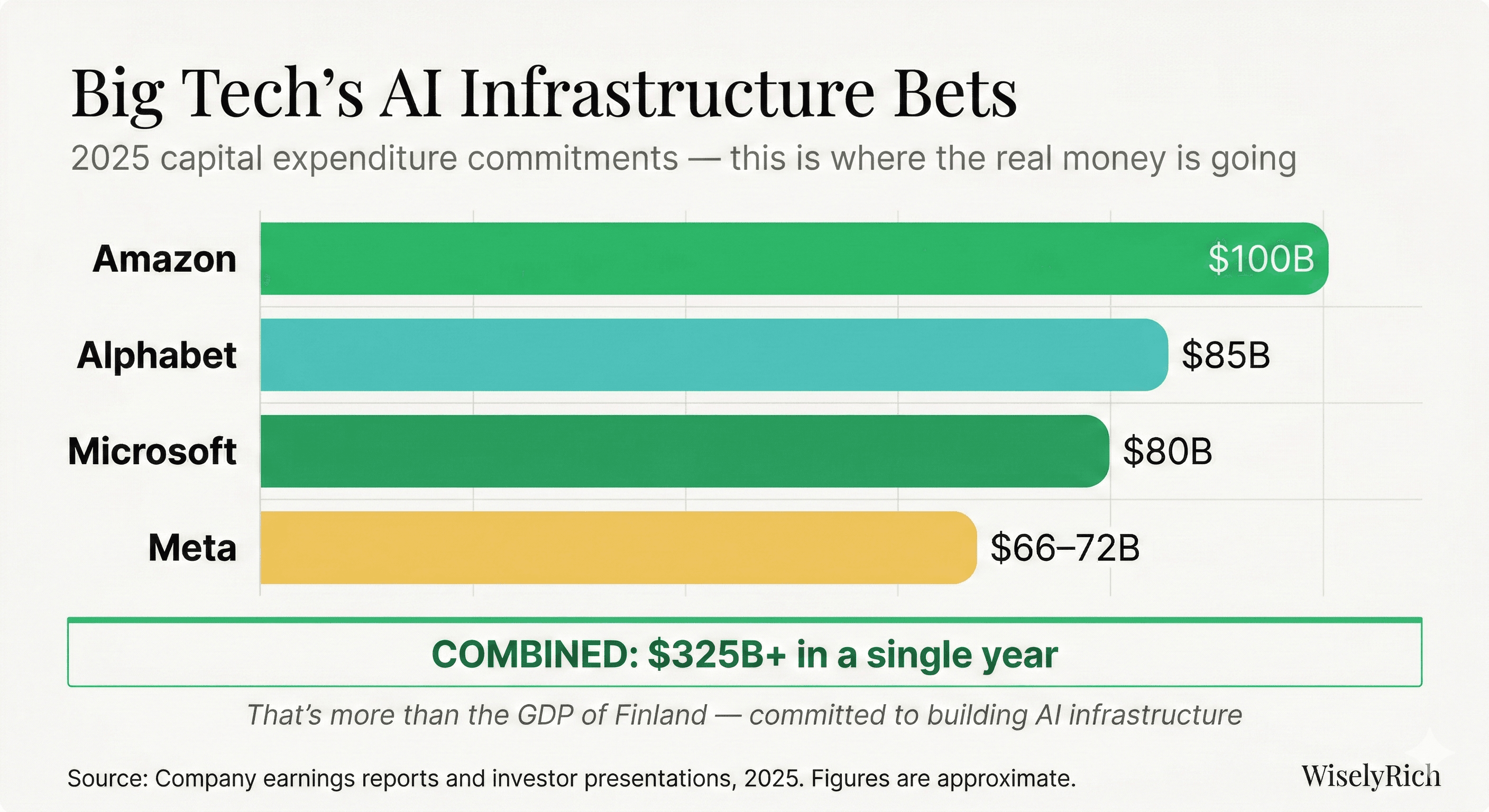
Big Tech is betting $325B+ on AI infrastructure in 2025 alone — more than Finland's entire GDP.
The internet changed everything — but it took 15 years from the first browser to the smartphone in your pocket. AI is following a similar arc. We're somewhere in the early innings, between the "everyone's excited" phase and the "this is actually transforming industries" phase.
If you zoom out far enough, the question isn't whether AI will create enormous value. It's whether you'll still be invested when it does.
The people who bought Amazon during the dot-com crash at $6/share and held didn't need to predict the iPhone, AWS, or Alexa. They just needed to believe that the internet mattered — and have the patience to stay in the game.
Your action step: Write down your investment time horizon. If it's less than 5 years, keep your AI allocation conservative. If it's 10+ years, you can afford to be more aggressive — because you have time to ride out every DeepSeek-style panic between now and then.
The Real AI Investment Most People Miss
Let's bring this full circle.
Remember that $589 billion Nvidia lost in a single day? It recovered. The people who panicked didn't.
The real risk in AI investing isn't that the technology fails. It's that you fail — by chasing hype, concentrating too heavily, panic-selling on bad headlines, or never starting because the noise made it feel too complicated.
Here's the hard truth: a year from now, AI will be bigger, more embedded in the economy, and more profitable for the companies building it. The only variable is whether you positioned yourself to benefit — patiently, strategically, and without betting the farm on a single stock ticker.
The smartest AI investment you can make right now isn't a stock. It's a system. An automatic contribution to a diversified portfolio with thoughtful AI exposure, running quietly in the background while you live your life.
The algorithm doesn't care about your emotions. But it does reward your consistency.
Start today: pick one AI ETF, set up a recurring $50 investment, and let the system work. That's it. That's the whole move.